

One of the biggest revolutions of our lifetime is the internet. It it needs no introduction. It has connected us, informed us, entertained us, and quietly rewired how the entire world works.
But every revolution has a shadow side. Along with the internet came cybercrime, data theft, ransomware, and a permanent, low-grade anxiety about who else might be reading our messages. As more of our lives moved online, that shadow got bigger. So the question is,
Can we ever build a communication network that is fundamentally impossible to hack?
Welcome to the Quantum Internet!
Every Secure Conversation Begins with a Secret
Whenever you send an encrypted message, whether it's a WhatsApp message or an online banking transaction, the first challenge is agreeing on a secret key.
Think of this key as a password that only the sender and the receiver know. Once both parties have the same key, they can use it to encrypt and decrypt messages.
In the quantum internet, this still happens in two steps:
Generate a secret key.
Use that key to encrypt the actual message.
Together with these two steps it is impossible to hack (read the above article). The second step is fairly well understood and easy. So the real challenge is Step 1, creating and sharing that secret key securely.
Step 1: Creating the secret key
Whenever we create a secret key, both the sender and the receiver must know it so they can encrypt and decrypt messages. The challenge is securely sharing that key. If either the sender or the receiver generates the key and transmits it over the internet, an attacker could secretly intercept it. This is why distributing secret keys securely has always been one of the biggest challenges in cryptography.
Quantum mechanics offers a remarkable solution. Using quantum states—or, even more remarkably, quantum entanglement—two distant parties can generate the same secret key without ever transmitting the key itself over the internet. Even better, any attempt by an eavesdropper to intercept the quantum information inevitably disturbs the quantum system.

This disturbance can be detected, allowing both parties to know that the communication has been compromised before using the key.
That is an extraordinary idea. Rather than hoping nobody intercepted your communication, you can actually know whether someone tried.
This entire process is known as Quantum Key Distribution (QKD).
Several famous protocols have been developed over the years, including BB84 and E91, each using different quantum principles to establish secure keys. The details of these protocols are fascinating enough to deserve articles of their own.
Step 2: Encoding and Decoding
After the secret key has been safely established, everything becomes much simpler. The communicating parties use that key to encrypt and decrypt their messages, ideally with the one-time pad (OTP). To learn how OTP works, read the article below—it's Episode #4 of our blog series.

The result is remarkable.
If the key is truly random, shared securely through quantum methods, and never reused, then the encrypted message is information-theoretically secure. No future computer, not even a quantum computer, can decrypt it without the key.
In principle, this is as secure as communication can possibly be.
The Biggest Challenge
So far, the idea sounds almost magical. If quantum mechanics lets us create secret keys that reveal any eavesdropping, why don't we already have a quantum internet?
The answer lies in how those quantum states are physically transmitted.
To generate a secret key (Step 1 above), we need to send quantum information from one location to another. In practice, the best carriers of this information are single photons—tiny packets of light. They naturally travel through the same optical fibres that already form the backbone of today's internet but we need extra infrastructure around it.
But there is a catch. Photons are incredibly fragile.
As they travel through hundreds of kilometres of optical fibre, some are absorbed or scattered by the material. Every photon that disappears takes a piece of the quantum information with it, making it harder—and eventually impossible—to establish the shared secret key.

Unlike ordinary internet signals, these quantum states cannot simply be copied and amplified along the way. Doing so would destroy the very quantum properties that make the communication secure.
This loss of photons over long distances is one of the biggest obstacles to building a practical quantum internet.
Why Are Governments Investing So Much?
Building such a network is incredibly difficult, but the potential benefits are enormous.
Secure communication is not just about protecting personal messages. It is crucial for finance, national security, healthcare, scientific research, and critical infrastructure.
This is why governments around the world are investing heavily in quantum communication technologies.
Many countries have already launched national quantum initiatives, built experimental quantum networks, and funded research into quantum communication. The long-term goal is to create communication systems that remain secure even in an age where powerful quantum computers may be capable of breaking many of today's encryption methods.
One of the most notable achievements is China's quantum communication network. In 2017, China built a 2,000 km quantum network, and efforts are now underway to extend it to approximately 4,600 km across the country.

What's Next?
If you would like a more in-depth scientific explanation, I recommend reading the original article by the late physicist J. Kimble.
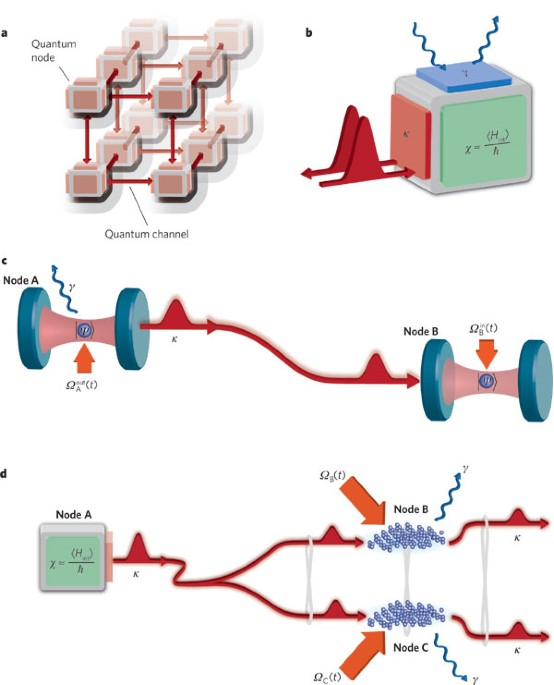
As we have seen, the biggest challenge is that photons are lost as they travel through optical fibers. Fortunately, scientists have developed remarkable techniques to overcome this problem. We'll explore those solutions in the next episode—stay tuned!
