

Last time we solved one of the biggest problems in building a quantum internet: photons (light particles) don't survive long journeys through optical fibers. Instead of asking a single photon to travel a thousand kilometers, we divided the route into many short segments, created entanglement across each segment, and stitched those segments together using entanglement swapping. That's the idea behind a quantum repeater (Read it here).
It's a beautiful solution. It's also incredibly difficult to build. Practical quantum repeaters need quantum memories that can store fragile quantum states for long enough, extremely precise synchronization, and hardware that still exists mostly inside research laboratories.
So while the world waits for repeaters to mature, researchers have been asking a much simpler question.
Do we really need the optical fibers at all?
Maybe the Problem Isn't Distance
Throughout this series we have been blaming distance for destroying our photons. But that's not quite true. The real culprit is the glass.
As a photon travels through an optical fiber, it constantly interacts with the material around it. Tiny imperfections scatter some of the light, a little gets absorbed, and a little simply leaks away. None of these effects is dramatic on its own, but after hundreds of kilometers almost every photon has disappeared.
So perhaps we have been solving the wrong problem.
Instead of asking "How do we keep photons alive inside fibers?", we could ask
"Can we avoid the fibers altogether?"
The Alternative to Fiber Is Space
Until now, we have always tried to fight photon loss inside optical fibers. But there is another option.
Why not move the entire network into space?
Light already travels through space every day. The sunlight reaching Earth has crossed 150 million kilometers of vacuum to get here. Space itself is not a problem for photons. The problem is everything between us and space: the atmosphere.
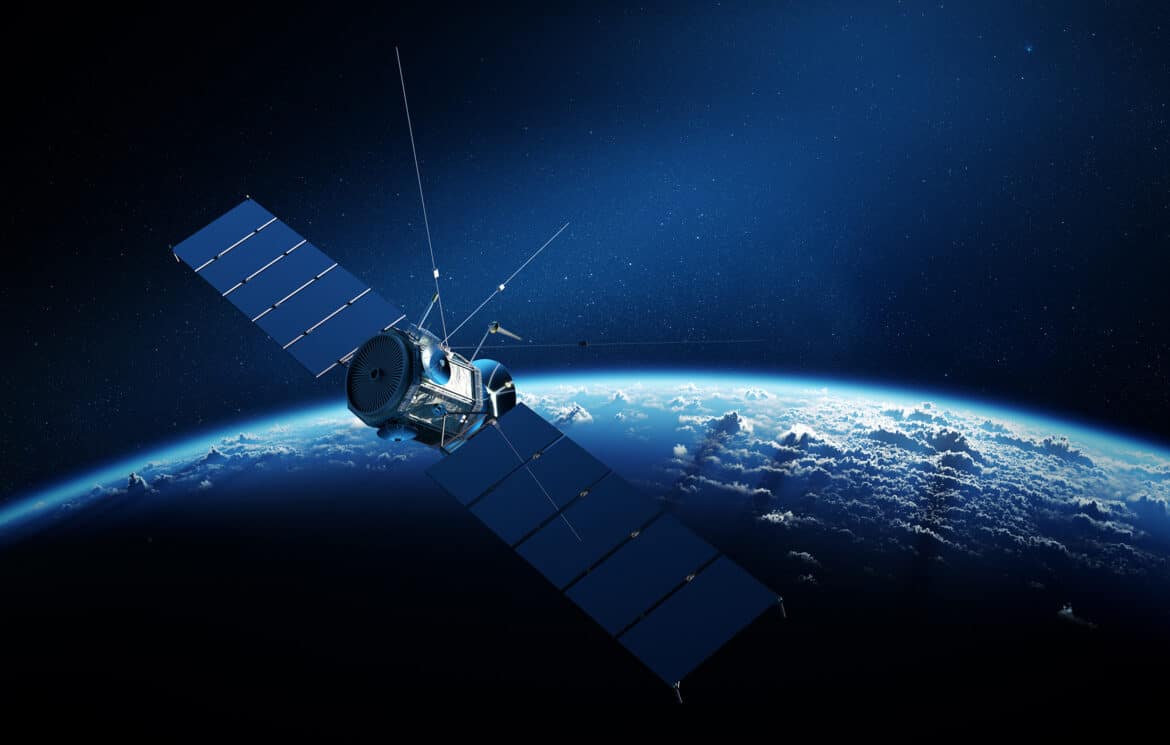
A quantum satellite uses the same idea as a repeater, but instead of placing stations along the ground, we place one above the Earth. Alice sends photons to the satellite, the satellite helps establish a quantum connection, and sends the photons down to Bob.
It is almost like Starlink for quantum communication—except instead of satellites carrying internet data, they distribute quantum states.
The reason this works is simple: most of the journey happens through empty space, where photons can travel with very little loss.
The Alternative to Fiber Is Right Above Our Heads
So far, every solution we've discussed has tried to fight the same enemy: distance.
A photon travelling from New York to London through an optical fiber has to survive thousands of kilometers inside glass. The longer the journey, the more photons disappear. That's why we invented quantum repeaters: break one impossible journey into many smaller ones, create entanglement over each short distance, and then combine those pieces into one long connection. But there is another way.
Instead of breaking the journey along the ground, why not move the journey above the ground?
After all, light already travels through space every day. The sunlight reaching Earth has crossed about 150 million kilometers of empty space to get here.
But Why Does Space Help?
The answer is simple: most of space is empty.
Once a photon leaves the atmosphere (less than100 km), it travels through almost perfect vacuum. There is no glass absorbing it, no impurities scattering it, and almost nothing for it to interact with.
The atmosphere is the difficult part. Air is constantly moving, and different layers bend light by tiny amounts. This turbulence can distort the beam and make it harder for a telescope to collect the photons.
But that difficult atmospheric layer is only a tiny fraction of the total journey.

A 500-kilometer path through space may actually be easier than a 100-kilometer path through fiber.
The shortest path for a photon is not always the shortest path on a map.
A Satellite as a Quantum Bridge
Imagine Alice in New York wants to share a secret key with Bob in London. The traditional approach is to connect them through fiber. But thousands of kilometers of fiber means thousands of kilometers where photons can disappear.
A satellite offers a different architecture.
Instead of sending the photon all the way across the Earth, Alice sends it upward to a satellite. The satellite then sends another photon back down to Bob.
The satellite becomes a middle station that helps create a quantum connection.

It is the same basic idea as a repeater: take a difficult long-distance problem and split it into smaller pieces.
The difference is that a quantum repeater splits the journey across the ground. A satellite splits the journey through space.
In a way, it is almost like building a quantum version of Starlink—not a network of satellites carrying ordinary internet packets, but a network of satellites distributing quantum states.
How Does It Actually Create a Quantum Key?
The most elegant version uses entangled photons. The satellite carries a source that creates an entangled pair of photons. One photon is sent toward Alice's ground station. The other is sent toward Bob's ground station.
The satellite is not transmitting a password or an encrypted file. It is creating a shared quantum relationship between Alice and Bob.
When Alice measures her photon and Bob measures his, their results are correlated because the photons were entangled at the satellite.
Later, they communicate through an ordinary classical channel to compare which measurement bases they used. They keep only the useful measurements, discard the rest, and turn the remaining correlated results into a secret key.
The satellite never learns the key. It never measures the photons. It only creates the entanglement and lets the photons go.
Nature Doesn't Give Free Lunches
Of course, replacing fibers with satellites doesn't magically solve everything.
It simply swaps one engineering nightmare for another.
A satellite moves at nearly 7 kilometers every second. It only stays above your horizon for a few minutes before disappearing again. During that brief window, a telescope on the ground must continuously track an object moving faster than a rifle bullet while keeping a laser beam pointed with extraordinary precision.
Then there's the atmosphere itself.
Unlike the vacuum of space, air is constantly moving. Warm and cold pockets have slightly different densities, causing light to bend by tiny amounts. The laser beam wobbles, spreads out, and sometimes misses the receiving telescope entirely.

If you've ever wondered why stars twinkle at night, you've already seen atmospheric turbulence in action.
So we traded one enemy for another.
Instead of photons being absorbed inside glass, they now struggle through Earth's turbulent atmosphere.
Meet Micius Satellite
While quantum repeaters are still being developed, satellite quantum communication has already become reality.
In 2016, China launched Micius, the world's first satellite dedicated to quantum communication.
Over the following years, it demonstrated quantum key distribution between distant ground stations, distributed entangled photons over more than a thousand kilometers, and even carried out one of the first demonstrations of quantum teleportation between Earth and space.
They demonstrated that global quantum communication is already possible—even without quantum repeaters. Checkout the links below for more!
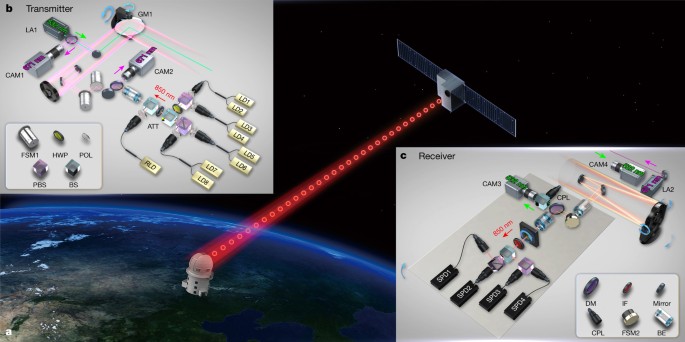
China's success sparked a worldwide race. Europe is developing its own quantum satellite infrastructure, the United States has multiple national programs underway, and India's National Quantum Mission also includes ambitious plans for satellite-based quantum communication.

The quantum internet is no longer confined to laboratories. It's heading into orbit.
So... Do Satellites Replace Quantum Repeaters?
Not at all.
Satellites and quantum repeaters solve the same problem in completely different ways.
Satellites avoid long fibers altogether by sending photons through space. Quantum repeaters accept that fibers are unavoidable but use entanglement swapping to overcome their losses.
Neither technology is likely to replace the other. A future quantum internet will almost certainly use both.
Short-distance networks inside cities may rely on optical fibers and quantum repeaters. Connections between distant cities—or even different continents—may travel through satellites before returning to the ground.
In many ways, this is exactly how today's internet already works. We don't rely on one communication technology. We combine Wi-Fi, fiber optics, cellular networks, microwave links, and undersea cables into one enormous system, each chosen because it's the best tool for a particular job.
The quantum internet will probably look much the same.
Sometimes the best path between two cities won't be through the ground. It'll be through space.
